

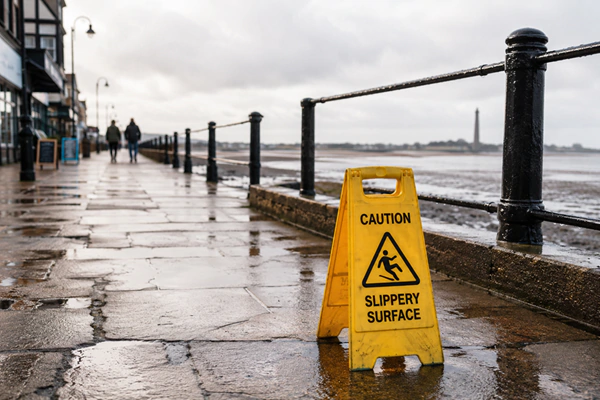
Crosby’s coastal setting, promenade, and public walkways make it a popular place to walk, exercise, and visit. People heavily use these areas throughout the year, from the beachfront paths to local high streets and residential pavements. However, these same environments can present risks when surfaces are uneven, poorly maintained, or unsafe in wet or high-footfall conditions.
If you’ve fallen in Crosby, the immediate concern is your safety. The next question is whether the accident could have been prevented and whether you may be entitled to compensation.
Understanding what to do early on can make a direct difference to both your recovery and your ability to take action. Often, what happens in the minutes and hours after a fall becomes just as important as the fall itself.
1. What to do immediately after a fall
The steps you take right after a slip, trip or fall are important. They help establish what happened and protect your position if you later decide to make a claim.
Key actions include:
- Report the incident as soon as possible to the relevant authority or business responsible for the area
- Take clear photographs of the exact location, including any visible hazard that caused the fall
- Get the contact details of anyone who witnessed the incident, even if they only saw part of what happened
- Seek medical attention, even if the injury seems minor at first, as symptoms can worsen later
- Make a note of the time, location, and surrounding conditions such as weather, lighting, or crowd levels
- Avoid returning to the area later without documenting it first, as hazards are often repaired quickly
These steps are not about making a claim immediately. They are about preserving accurate information while it is still available. In public areas like Crosby’s promenade, conditions can change quickly, and without early evidence, it can become difficult to demonstrate what caused the accident.
2. How liability is assessed after a fall
Responsibility for a fall in Crosby depends on where and how it happened, and more importantly, whether the hazard should have been dealt with before the incident occurred.
The local authority may bear responsibility for improper maintenance on public walkways like the promenade or pavements. Uneven paving, erosion from coastal conditions, and hazards left unresolved for an extended period are examples of this.
In commercial settings such as cafés, restaurants, or shops, responsibility may sit with the business itself. This often involves issues such as wet floors without warning signs, cluttered walkways, poorly positioned furniture, or inadequate lighting.
In some situations, responsibility can also involve third parties, such as contractors responsible for maintenance or cleaning. The main issue is not who owns the space, but who made sure it was safe.
A structured example helps clarify this:
- Location: Crosby promenade
- Incident: uneven or worn surface combined with wet conditions
- Outcome: loss of footing leading to a fall injury
- Key issue: whether the defect had been identified and left without repair
This type of breakdown shows how liability is assessed in practice. It is not about proving the fall happened, but about showing that the conditions leading to it should have been addressed.
At this stage, the key is not guessing who is at fault, but understanding whether the risk was avoidable. Speaking to a firm such as Marley Solicitors can help assess whether proper maintenance or safety procedures were followed based on the specific circumstances of the incident.
3. When you can make a claim
Not every fall leads to a valid claim. The key requirement is that the accident was caused by negligence, rather than being unavoidable.
A claim may be possible where:
- There was a clear hazard that created an unnecessary risk
- The responsible party failed to take reasonable steps to fix or manage that hazard
- The injury can be directly linked to the unsafe condition
- There is evidence showing how and where the incident occurred
- The claim is made within the legal time limit of three years
It is also important to understand what does not usually qualify. If a surface was clearly safe and maintained, or the fall occurred due to factors outside anyone’s control, a claim may not succeed.
The strength of a claim often depends on how clearly the hazard can be identified and how well it is supported by evidence. This is why early documentation, such as photographs and witness details, plays a critical role.
4. What compensation can include
Compensation is intended to reflect the full impact of the accident, not just the fall itself. This includes both the immediate effects and any on-going consequences.
Such damages may include:
- Loss of earnings if you are unable to work during recovery
- On-going financial impact if your ability to work is reduced
- Medical treatment, physiotherapy, or rehabilitation costs
- Travel expenses related to treatment or appointments
- The physical pain and disruption caused by the injury
- The effect the injury has on your daily routine and independence
In a location like Crosby, where walking routes and public spaces are a central part of daily life, even a relatively straightforward fall can disrupt normal activity. Simple things such as walking to local shops, exercising, or commuting can become difficult.
Compensation takes this broader impact into account. It is not limited to the incident itself but considers how the injury affects your day-to-day life over time.
Moving forward after a fall in Crosby
A slip, trip or fall can happen quickly, but the consequences can last much longer. What matters is whether the accident could have been prevented through proper maintenance, reasonable care, or basic safety measures.
If it could have been prevented, it should not be dismissed as unfortunate luck. Understanding what happened, and taking the right steps early, puts you in a stronger position to decide whether a claim is appropriate.
Acting sooner rather than later helps ensure that evidence is preserved and that your situation can be assessed clearly.