

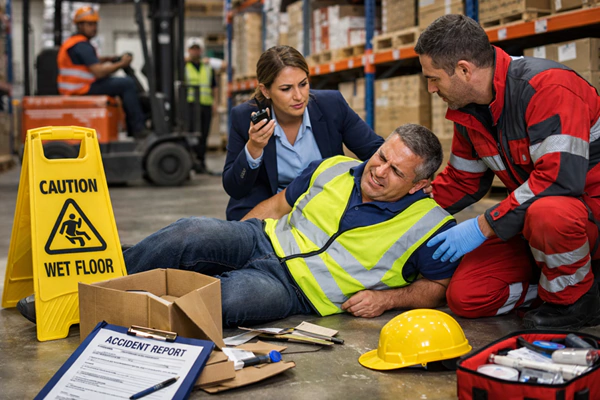
Netherley is a primarily residential area, but many residents work in nearby retail, care, warehouse, and service roles across Liverpool. Workplace accidents can happen in any of these environments, yet many employees are unsure what their rights actually are when something goes wrong.
A common issue is not the accident itself, but the misunderstanding that follows. People often assume that if they were involved in the situation, then they must be at fault or that raising it could create problems at work. In reality, workplace safety is structured around employer responsibility, and understanding that changes how these situations should be viewed.
The reality of workplace accidents
Workplace accidents are often seen as isolated incidents, but in many cases, they are the result of how a job is structured rather than a single mistake.
An employee may slip while carrying out a task, strain themselves lifting, or be injured using equipment. The immediate reaction is often to think it was just “one of those things” or that it could have been avoided by being more careful.
However, the more important question is whether the task itself was set up safely in the first place. Were the correct systems in place? Was the workload reasonable? Was the environment properly maintained?
In many cases, accidents are not purely down to individual action. They are influenced by the conditions people are working in.
What employers are actually responsible for
Employers have a legal duty to take reasonable steps to keep employees safe while they are at work. This responsibility applies across all types of workplaces, whether it’s a shop, care setting, warehouse, or office.
This includes ensuring:
- Safe systems of work are in place for everyday tasks
- Employees are properly trained for the work they are expected to do
- Equipment is suitable, maintained, and safe to use
- The working environment is free from avoidable hazards
- Risks are identified and managed appropriately
- Workloads and expectations do not create unsafe pressure
These responsibilities are not optional. They form the foundation of workplace safety. If an accident happens because one or more of these areas were not properly managed, it may point towards a preventable issue, highlighting the need for employees to recognise their role in maintaining safety protocols and addressing potential hazards proactively.
What employees often get wrong
A major barrier for employees is the set of assumptions they make after an accident.
One of the most common is the belief that making a claim will cause problems with their employer. In reality, employees are protected, and raising a legitimate issue about workplace safety is not the same as creating conflict.
Another misconception is that if the employee played any role in the accident, they cannot claim. This is not always the case. Many workplace incidents involve a combination of factors, and responsibility can still sit with the employer if the overall conditions were unsafe.
The belief that an injury must be severe is also prevalent. In practice, even injuries that seem minor at first can develop over time and affect the ability to work or carry out normal activities.
To put this into context, imagine an employee in a Netherley-based retail role regularly lifting stock without proper training or support. Over time, they develop a strain injury. Initially, they assume it is just part of the job. Later, it becomes clear that proper training and lifting procedures were never established.
In that situation, the issue is not just the injury itself but the lack of structure around how the task should have been carried out safely.
When you should consider taking action
Not every workplace accident leads to a claim, but there are clear situations where it is worth considering.
This includes where:
- The injury has had a noticeable impact on your ability to work or carry out daily activities
- The accident was caused by a risk that should have been identified and managed
- There is a pattern of similar issues in the workplace
- Proper training, equipment, or supervision was not provided
The key factor is whether the situation was preventable. If the conditions that led to the accident were avoidable and not addressed, that is when action becomes relevant.
Understanding this point of view does not mean you must act immediately. It means you are aware of your position and can make an informed decision based on what actually happened.
At this stage, speaking to Marley Solicitors can help clarify whether the circumstances of your accident point to a failure in workplace safety and whether your situation meets the criteria for a claim.
What compensation may include
Where a claim is valid, compensation is intended to reflect the impact of the injury rather than just the event itself.
This can include:
- Loss of earnings during recovery
- On-going financial impact if your ability to work is affected
- Medical treatment or rehabilitation costs
- The physical effects of the injury
- The disruption to your normal routine and daily life
Even in roles that may not seem high risk, injuries can still have a lasting effect, particularly where physical tasks are involved.
Moving forward after a workplace accident in Netherley
Workplace accidents are often misunderstood because they are viewed as isolated or unavoidable. In reality, many of them are tied to how work is organised and managed.
Understanding your rights is not about creating problems at work. It is about recognising when the proper standards may not have been met.
If your injury was preventable, taking time to understand your position allows you to decide what to do next with clarity rather than assumption.