

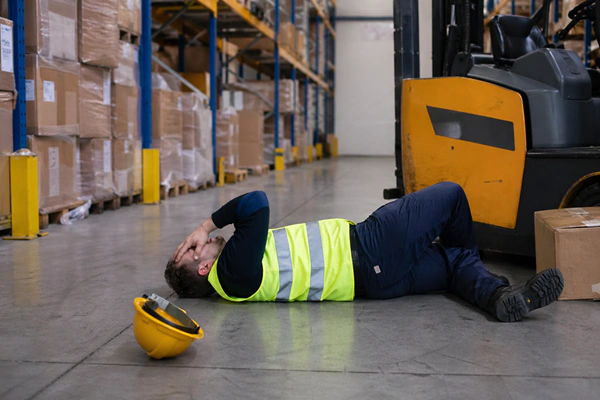
Kirkby is home to a large number of factories, warehouses, and distribution centres. These environments are built around efficiency, movement, and output, with staff often working to tight schedules and physical demands. Despite the expectation of safety systems, improper implementation or maintenance can still lead to accidents.
If you sustained injuries in a Kirkby factory or warehouse, your legal rights extend beyond the incident itself. They depend on what should have been in place to prevent it and whether those standards were met.
Understanding how these situations typically unfold over time makes it easier to see where responsibility sits and what action may be available.
The moment the accident happens
In a busy warehouse or factory, accidents often occur during routine tasks. Lifting stock, operating machinery, moving goods between areas, or working in fast-paced loading zones can all create risk if safety procedures are not actively managed.
A manual handling injury could occur due to improper control of weight or technique. It could involve machinery where safeguards were missing or not functioning correctly. In other cases, it may be something as simple as a poorly maintained floor or obstructed walkway causing a fall.
What these situations have in common is that they are usually predictable. Most incidents happen in environments where pressure, repetition, or lack of oversight allows risk to build.
At the point the accident happens, the immediate focus is usually on the injury itself. However, from a legal perspective, the key question is already forming: should this have been prevented?
The immediate aftermath
Once an accident occurs, the response that follows can vary depending on how well the workplace is managed.
In a properly run environment, the incident should be recorded, the area made safe, and the injured person given appropriate support. There should be a clear process for reporting what happened and identifying the cause.
In reality, this does not always happen as it should. In some cases, incidents are recorded with limited detail. In others, the focus is on resuming operations quickly rather than understanding what went wrong.
This stage is important because it creates the first record of the event. If the details are incomplete or unclear, it can make it more difficult to establish what actually happened later.
Seeking medical attention at this point is also critical, even if the injury appears manageable. Some workplace injuries, particularly those involving strain or impact, can worsen over time.
The days and weeks after
As time passes, the full impact of the injury often becomes clearer. What initially seemed minor can develop into something more serious, affecting mobility, comfort, and the ability to work.
Requiring time away from work can lead to financial strain, especially in physically demanding roles with limited alternative duties. Even when returning to work is possible, it may not be at the same capacity as before, potentially leading to further financial strain and challenges in fulfilling job responsibilities.
This period also raises practical questions. How did the accident happen? Was the correct training provided? Was the equipment suitable? Were the working conditions reasonable?
These questions shift the focus away from the incident itself and towards the conditions that led to it. This is where the situation moves from being an accident to something that may involve responsibility.
A typical timeline example
To understand how this unfolds in practice, consider a simplified progression:
- Before: A worker is carrying out a routine task during a busy shift with limited supervision and pressure to maintain pace
- During: An injury occurs while lifting or operating equipment, often without immediate clarity on what caused it
- After: The incident is recorded, but the underlying cause is not fully explored, and symptoms worsen over the following days
This kind of progression is common in warehouse and factory environments, where the pace of work can overshadow the need to properly assess risk.
How responsibility is evaluated
Once the immediate situation has passed, the focus turns to whether the accident was avoidable.
Employers have a legal duty to provide a safe working environment. In factories and warehouses, this means making sure that workers are well-trained, that the equipment is appropriate and well-maintained, and that the way work is done is safe and realistic.
Responsibility may arise where training has not been updated, where equipment is inadequate or faulty, or where workloads create unsafe pressure. It can also arise where known risks are not addressed or where supervision is lacking.
The key issue is not whether an accident occurred, but whether reasonable steps were taken to prevent it. If those steps were missing or insufficient, the employer may be held responsible.
In some cases, responsibility may also involve other parties, such as contractors responsible for maintenance or equipment providers. The specifics depend on how the workplace is structured and who controls different aspects of safety.
What your legal rights actually mean
Your legal rights are designed to ensure that you are not left dealing with the consequences of an avoidable workplace injury on your own.
If a workplace safety failure caused the accident, you may be eligible to file a claim for compensation. This is not limited to the injury itself but can include the wider impact on your income, your ability to work, and your day-to-day life.
You are also protected from being treated unfairly for asserting these rights. Making a claim is not about creating conflict with an employer. It is about addressing a situation where proper standards were not met.
There is also a time limit for taking action. In most cases, a claim must be made within three years of the accident, although it is usually better to act sooner while details are still clear.
At this stage, understanding your position becomes important. Speaking to a firm such as Marley Solicitors can help assess whether the accident was preventable and whether your situation meets the criteria for a claim based on the conditions you were working in.
Moving forward after a workplace accident in Kirkby
A factory or warehouse accident can feel like a single moment, but its effects often unfold over time. What matters is not just what happened, but whether it should have happened at all.
If the injury was the result of preventable failures in training, equipment, or working conditions, leaving it unaddressed can have longer-term consequences. Knowing your rights helps you make informed decisions based on reality, not assumptions.