

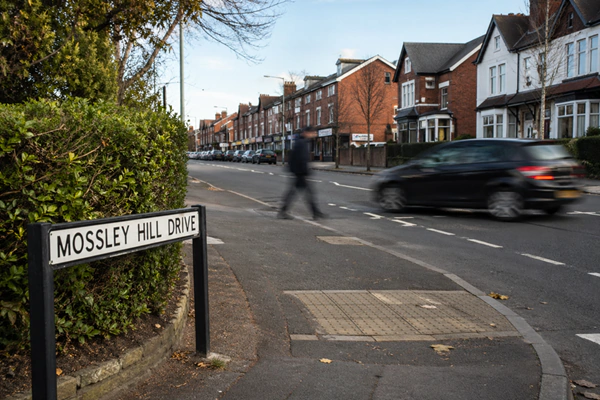
Mossley Hill is a largely residential area, with tree-lined streets, local shops, and regular commuter traffic moving through it each day. Pedestrians often rely on crossings, side roads, and junctions to move safely through the area, but when visibility, speed, or attention is misjudged, accidents can happen quickly.
If you’ve been injured as a pedestrian in Mossley Hill, the key issue is not just the accident itself, but what led to it and what you should do next. Understanding this starts with looking at how these situations typically unfold in real life.
A realistic pedestrian accident in Mossley Hill
Imagine walking along a residential road in Mossley Hill during late afternoon. Traffic is steady but not congested. You approach a crossing point near a junction, where parked cars partially restrict visibility.
You begin to cross, assuming it is safe to do so. At the same time, a vehicle approaches the junction and turns without clearly checking for pedestrians. The driver’s view is limited, but the turn is made regardless.
Contact is made at low speed but is enough to cause injury. You fall, experience immediate discomfort, and the situation becomes unclear in the moment. The driver stops, but there is confusion about what happened and who was at fault.
In situations like this, what matters is not just the collision but the conditions leading up to it. Was the driver paying sufficient attention? Was the turn made safely? Could the incident have been avoided with reasonable care?
At an early stage, understanding how these questions are assessed can make a difference. Speaking to Marley Solicitors can help clarify whether the circumstances of the incident point towards a preventable situation based on how the road and traffic interaction were managed.
What happens next after a pedestrian accident?
In the immediate aftermath of a pedestrian accident, the focus is often on the injury itself. However, the steps taken during this stage can affect what happens later, such as the legal and insurance processes that may follow the accident.
Medical attention should always be a priority, even if the injury initially feels manageable. Some injuries, particularly those involving impact or strain, may not fully present until hours or days later.
At the same time, details about the incident can begin to fade if they are not recorded. The location, position of the vehicle, visibility conditions, and any witness observations all play a role in understanding what happened.
Where possible, it helps to:
- Note the exact location of the incident, including the road or junction
- Record the vehicle details and driver information
- Speak to any witnesses who saw the incident
- Take photographs of the area, including visibility conditions or obstructions
These steps are not about making a claim immediately. They aim to guarantee a precise understanding of the incident in the future.
How responsibility is determined in pedestrian accidents
Whether those involved took reasonable care determines responsibility in pedestrian accidents.
Drivers are expected to remain aware of their surroundings, particularly in residential areas where pedestrians are likely to be present. This includes adjusting speed, checking blind spots, and approaching junctions with caution.
In the scenario described, the key issue would be whether the driver took sufficient care when turning into the junction. Limited visibility does not remove responsibility. It increases the need for caution.
At the same time, pedestrian behaviour can be considered. The crossing location, pedestrian visibility, and conditions may all be relevant.
The assessment is not about assigning blame instantly. The assessment aims to determine if taking reasonable care could have prevented the accident.
When can you make a claim as a pedestrian?
A claim may be possible if the accident was caused by a failure to take reasonable care.
In pedestrian cases, this often involves situations where a driver did not properly observe their surroundings, misjudged a turn, or failed to anticipate pedestrian movement in a residential or urban setting.
The key factors usually include whether:
- The driver had a clear opportunity to see and respond to the pedestrian
- The manoeuvre was carried out safely given the conditions
- The injury can be directly linked to the incident
Time also plays a role. In most cases, there is a three-year period in which a claim can be made, but acting earlier helps ensure that evidence and recollection remain accurate.
Using the earlier scenario, if the driver turned without properly checking despite restricted visibility, this may point towards a preventable situation. That is what forms the basis of a potential claim.
What compensation may include
Compensation is intended to reflect the wider impact of the accident, not just the moment it occurred.
This can include loss of earnings if time away from work is required, medical treatment or rehabilitation costs, and the on-going effect the injury has on daily life.
In pedestrian cases, even relatively low-speed incidents can result in injuries that affect mobility or confidence when moving through similar environments. The assessment of compensation takes these effects into consideration.
Moving forward after a pedestrian accident in Mossley Hill
Pedestrian accidents often happen in situations that feel routine at the time. Crossing a road, walking through a junction, or moving between streets are everyday actions. When something goes wrong, it can feel unexpected, but it is rarely without cause.
What matters is the proper management of the conditions that led to the accident. If reasonable care was not taken and the incident could have been avoided, it may be worth understanding your position more clearly.
Taking steps early, both in terms of documenting the incident and understanding your rights, allows you to move forward with a clear view of what options are available based on what actually happened.